What is Asset Allocation?
In the world of investing, you will often hear the term “Asset Allocation”. Asset allocation, as the name suggests, is the distribution of each asset class in your investment portfolio. The two most common asset classes that are considered when building a portfolio are stocks and bonds. Stocks are the high-risk, high reward asset and bonds, also referred to as “fixed income”, are the low-risk, low reward asset. There are other assets classes that exist such as cash, commodities, real estate, precious metals, and, in recent years, crypto currencies. Understanding how to balance these asset classes is key to building a portfolio that aligns with your financial goals.
What is the Goal of Asset Allocation?
The goal of asset allocation is to manage risk. Each individual has their own tolerance for risk, and it is up to the individual to determine how much risk they are willing to take. It can take several years to figure out how much risk you are comfortable with and as you go through different stages of life your risk tolerance will change.
As a general rule of thumb you want to take on more risk in your younger years and less risk in your older years. This is because, when you are younger, you have more time to recover from a market crash. When you are older, you do not want to risk delaying retirement or having to go back to work (if you are already retired) due to a market downturn. Therefore, it’s better to have a lower-risk asset allocation.
Age-Based Asset Allocation Methods
First, we will look at some of the more common methods of asset allocation. As I mentioned earlier, your asset allocation will change throughout your life. Because of this, most mainstream asset allocation methodologies are based on one’s age. Prior to the 1990s, the most common rule of thumb was 100 minus your age in stocks. So, if you are 30 years old, you would have 70% (100 - 30) of your portfolio invested in stocks, and the remaining 30% would be invested in bonds. If you are 60 years old, then you would have 40% (100 - 60) of your portfolio invested in stocks, and the remaining 60% would be invested in bonds.
Over time, the 100 minus your age rule has shifted to favor more stock exposure. The rule eventually became 110 minus your age in stocks and is now more commonly 120 minus your age in stocks. This change was primarily due to interest rates becoming lower in the 1990s and 2000s, and then eventually nearing 0 after the Great Financial Crisis in 2008.
Fed Funds Rate from 1974-2024

Stock/Bond allocation for age-based methodologies from age 20-70
| Age | 100 minus age | 110 minus age | 120 minus age |
|---|---|---|---|
| 20 | 80% / 20% | 90% / 10% | 100% / 0% |
| 30 | 70% / 30% | 80% / 20% | 90% / 10% |
| 40 | 60% / 40% | 70% / 30% | 80% / 20% |
| 50 | 50% / 50% | 60% / 40% | 70% / 30% |
| 60 | 40% / 60% | 50% / 50% | 60% / 40% |
| 70 | 30% / 70% | 40% / 60% | 50% / 50% |
Asset Allocation Based on Percentage of Progress Toward Retirement
One of the main pros of age-based asset allocation is its simplicity. You only need to check your portfolio once a year, usually on your birthday, and update your asset allocation. However, there are a few edge cases where pursuing an age-based asset allocation may not be the best option. On one side of the spectrum, you have those who started investing aggresively at a young age in pursuit of early retirement. Conversely, there are people who didn’t start investing until later in life, for example, in their 40s or beyond.
In the former case, the individual might want to transition to bonds earlier in life to preserve their wealth as they approach early retirement. In the latter scenario, those who are older but are just getting started with investing might want to lean more toward stocks as they catch up to where they want to be.
For these individuals, or anyone who may prefer an alternative method, you can use the following formula:
Bond Allocation = Percentage of Progress Toward Retirement / 2
This formula requires you to know your target retirement goal in advance. Although determining your retirement goal is outside the scope of this post, a general rule of thumb is to multiply your annual expenses by 25. So, if you spend $50,000 a year, you will need $1,250,000 ($50,000 × 25) to retire.
In this scenario, if you have $125,000 in investments, then you are 10% toward your retirement goal. Dividing by 2 gives you 5%, so you would allocate 5% of your investments to bonds and 95% to stocks.
See the following table to understand how your asset allocation would change over time using this method.
| Total Investments | Investment Goal | Percent Towards Retirement | Stock/Bond Allocation |
|---|---|---|---|
| $10,000 | $1,250,000 | < 1% | 100% / 0% |
| $50,000 | $1,250,000 | 4% | 98% / 2% |
| $100,000 | $1,250,000 | 8% | 96% / 4% |
| $500,000 | $1,250,000 | 40% | 80% / 20% |
| $1,000,000 | $1,250,000 | 80% | 60% / 40% |
| $1,250,000 | $1,250,000 | 100% | 50% / 50% |
| $1,500,000 | $1,250,000 | 120% | 40% / 60% |
From looking at the table, you can observe some interesting details regarding this method. First, when you reach your retirement goal, your portfolio will be split 50/50 between stocks and bonds. Additionally, the change in asset allocation is exponential rather than linear. In the beginning, your asset allocation may not change much or at all year-to-year, but as your wealth increases, you are likely to adjust your bond allocation by several percentage points in a single year.
Another important point is that the stock-to-bond allocation doesn’t always move in the same direction over time. If there is a market downturn that causes your portfolio to decrease in value, moving you further away from your retirement goal, your target asset allocation will adjust accordingly. This means you may need to decrease your bond allocation and increase your stock allocation. This is probably my favorite part of this method, as it encourages you to buy more stocks at a lower price during a market downturn.
Target Date Funds
For those who don’t care much about investing and prefer a “set it and forget it” approach, there’s a method for you. Although it’s likely that these individuals aren’t reading this blog post, those who are may want to help a family member or friend who isn’t concerned with investing. For these individuals, Target Date Funds (TDFs) offer a simple solution. These funds are commonly available in employer-sponsored 401(k) accounts and are typically managed by large investment companies like Vanguard, Schwab, Fidelity, or BlackRock.
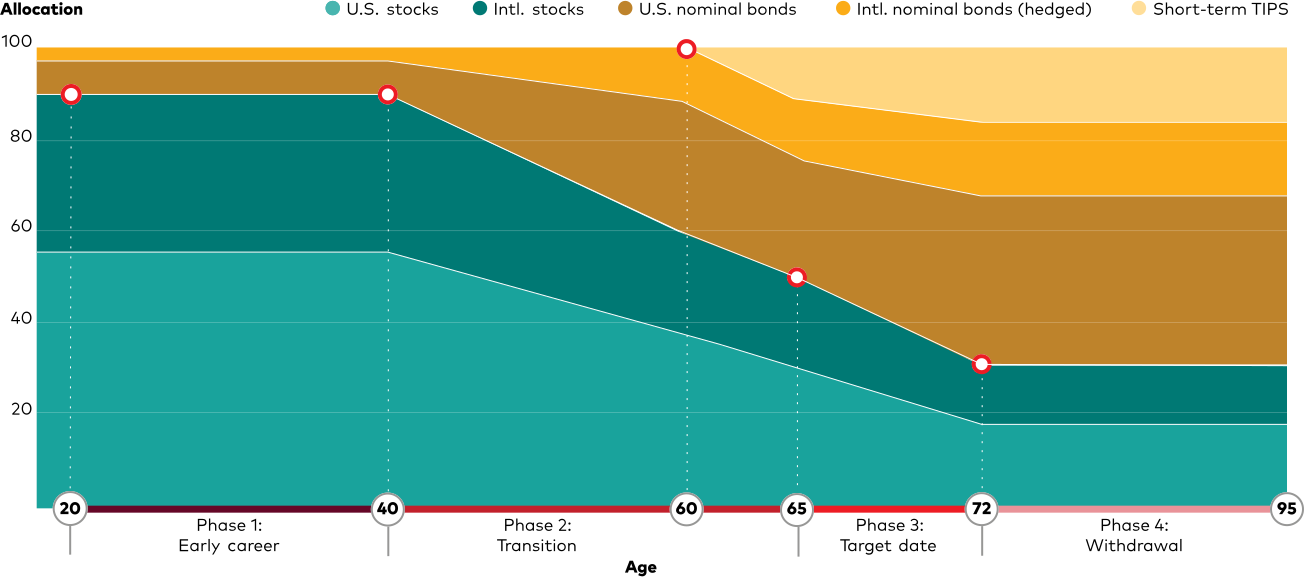
TDFs are easily identifiable by the target retirement year in the fund’s name, such as “Vanguard Target Retirement 2070 Fund.” The company managing the fund will adjust the underlying investments over time based on how close the retirement year is. How the company changes the investments over time is what’s known as the glide path. While each company has its own unique glide path, they all follow the same general principle: maintain high exposure to risk when far from retirement and gradually reduce that exposure as the retirement year approaches.
Below is an example of a Glide Path by Vanguard.
Conclusion
In conclusion, asset allocation is a crucial aspect of building a well-balanced investment portfolio, designed to help you achieve your financial goals while managing risk. Whether you’re following an age-based strategy, the progress-to-retirement method, or opting for the simplicity of Target Date Funds, the key is to find an approach that aligns with your risk tolerance, time horizon, and willingness to put in the effort to manage and adjust your investments over time. As your financial situation evolves, it’s essential to regularly reassess your allocation to ensure it continues to reflect your objectives. By understanding the different asset classes and allocation strategies available, you can confidently navigate the investment landscape and work toward long-term financial success.